First Ukrposhta delivery to Little Starhorodivka
Grey BeesThe first Ukrposhta delivery to Little Starhorodivka turns a single bag of letters into a rare link between an isolated village and the world beyond the front. The van’s arrival is greeted as something close to hope, yet the letters travel on roads shadowed by war, arrive in a village whose street names have been reversed, and bring Sergey Sergeyich a belated family greeting he cannot answer aloud.
Arrival on the road
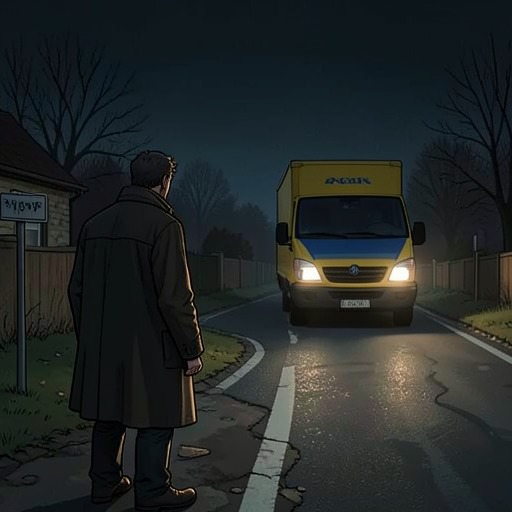
On the day of the “Postal Ceasefire”, Sergey Sergeyich and Pashka Khmelenko wait for the mail. From Karuselino, Little Starhorodivka lies only two kilometres away as the crow flies, but the road stretches three and a half kilometres and requires slow, careful driving to avoid sliding into the roadside channels. The approach of the van is therefore prolonged: at first it is only a moving dot beneath the horizon, and it takes several minutes before Sergey Sergeyich can be sure it is coming toward them. The vehicle’s yellow-and-blue paint identifies it with Ukraine, while its approach from the direction of the Donetsk People’s Republic makes its presence seem improbable. Sergey Sergeyich experiences the sight as strangely cheering, as if the van might be bringing peace along with the mail, though he knows that peace is more commonly associated with a tank. The vehicle offers no resolution to the war; its significance lies in the fact that it has reached the village at all.
A delivery under wartime conditions
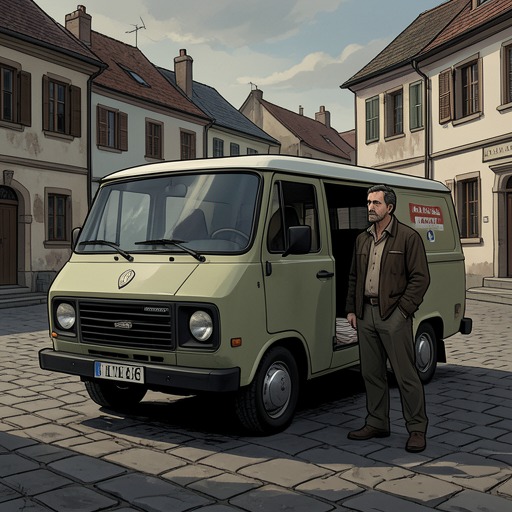
The driver stops to confirm that the destination is Little Starhorodivka. He and his companion get out with Sergey Sergeyich and Pashka, and the driver opens the rear doors after working a screeching iron latch. Inside are yellow waterproof bags. One is marked for the village; the next is bound for Svitle, and the companion unfolds a map to find the road there. The delivery is thus part of a route continuing through the same exposed, difficult landscape, not an isolated visit staged outside the conditions of the front. The quantity of mail is modest. Pashka asks whether there are packages as well as letters, but the driver explains that the packages have been sent back and that only letters were kept, because nothing inside them can go off. Pashka signs beside the X and prints his surname to acknowledge receipt. The precaution makes the limits of wartime communication tangible: some correspondence can be carried, while other parcels are judged unsafe to transport. The first delivery restores a channel, but not an ordinary postal service untouched by danger.
Letters, streets, and local improvisation
Pashka insists on untying the bag himself. The letters spill onto the table, their envelopes carrying many kinds of handwriting but addresses for only two streets, Lenin and Shevchenko. By then the names have been reversed in the village: Lenin Street is now Shevchenko Street, and Shevchenko Street is now Lenin Street. The senders do not know that the labels have changed. The physical mail arrives, but the familiar system for directing it has been unsettled by a political change that has not yet reached the correspondents’ understanding. The receipt of the letters also depends on local arrangements rather than a fully functioning postal network. Pashka takes the empty mailbag away, saying it could be useful around the house, and keeps it with the other things he stores behind a kitchen door he does not leave open. His practical appropriation gives the delivery an afterlife within the household: even the container is too useful to discard in a village where ordinary supplies and services are scarce.
Delayed contact and its cost
After the postal work, Sergey Sergeyich discovers a New Year’s card from Vitalina and Angelica in his pocket. It wishes him wisdom, health, and peace, and is signed by both women. The greeting has travelled for two months before reaching him. He rereads the neat handwriting by candlelight and thinks it would have been good to receive the card earlier, when he spent New Year’s Eve alone, waiting for midnight before drinking honey vodka and going to bed. The postal delay makes the card both a tender sign of continuing family connection and a record of the time in which that connection failed to arrive when it was most needed. The card prompts Sergey Sergeyich to find their number on his mobile phone and call. When a familiar voice answers and asks who is speaking, he cannot make himself reply. He hangs up, and tears come to his eyes. The delivery has made contact possible in two forms—an envelope from home and a live telephone connection—but it has not made estrangement easy to overcome. The message arrives; speech does not.
The fragile measure of connection
The novel places the delivery amid material conditions that make time and contact precarious. On the cold March morning, Sergey Sergeyich heats water over coal in a potbelly stove; the house is warmer than the damp yard, but the approaching spring has not yet removed the chill. Later, as he drives away from home, he worries that he has left his wound-up alarm clock behind. Once it stops, he imagines, the house will have no living time until someone returns to wind it. The postal arrival belongs to the same fragile network of ordinary supports: a stove, a clock, a road, a bag, a letter, a working phone. At the crowded checkpoint, Sergey Sergeyich’s mood collapses while soldiers inspect his passport and mobile phone. In the deepening darkness, headlights form a chain of waiting cars stretching back toward the distance from which he has come. The contrast clarifies what the first delivery briefly achieved. Ukrposhta’s van crossed a difficult route and made the village visible to an outside institution, but a single arrival cannot undo isolation, guarantee safe movement, or restore the relationships that the letters carry. Its importance is quieter and more exact: amid war, a bag of letters reached Little Starhorodivka, and for a moment the village could receive news from beyond itself.